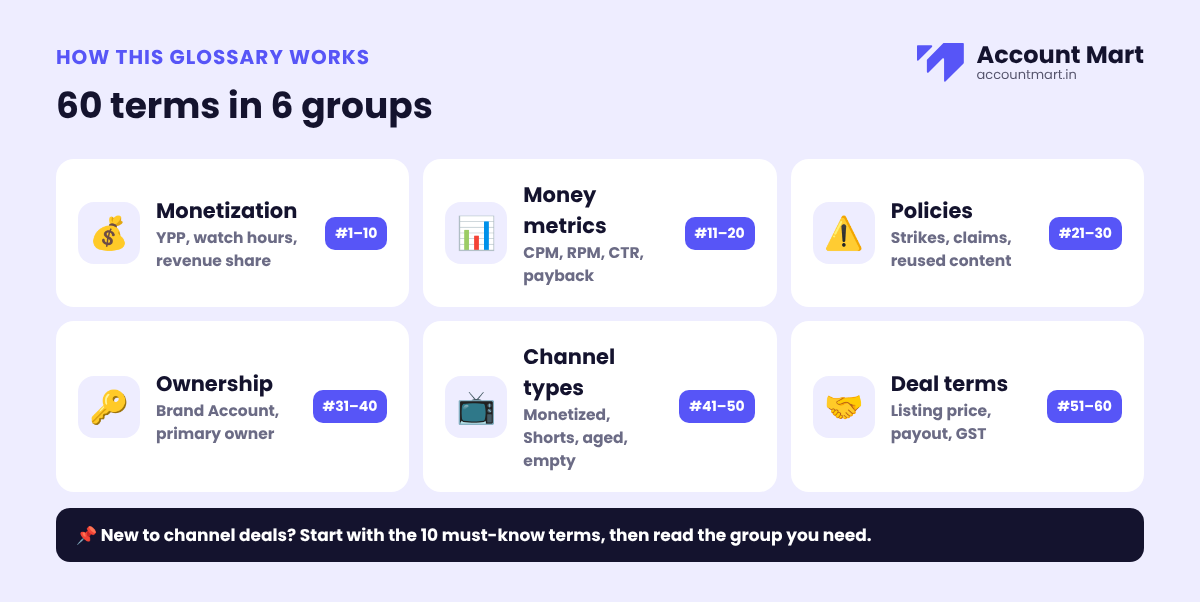
Quick answer: YouTube channel buying terms fall into six groups: monetization (YPP, watch hours, revenue share), money metrics (CPM, RPM, payback), policies (strikes, Content ID claims, reused content, limited ads), ownership (Brand Account, primary owner, the 7-day rule), channel types (monetized, Shorts, aged, empty) and deal terms (listing price, seller payout, due diligence, GST invoice). This glossary explains all 60 in plain English, with links to our detailed guides.
· 13 min read · By Ridhaan Choudhary, Founder & CEO
Key takeaways - The three terms that protect you most: Brand Account, primary owner and the 7-day rule. A real transfer never needs a password. - RPM is what the creator earns per 1,000 views; CPM is what advertisers pay. Do not mix them up when valuing a channel. - A copyright strike and a Content ID claim are different things. Only strikes count toward channel termination. - Listing price is the buyer price. Sellers receive less. - Bookmark this page. Every term links to a deeper guide when you need it.
Buying or selling a YouTube channel comes with its own vocabulary. Sellers talk about "YPP-approved Shorts channels with clean strikes". Buyers ask about "RPM", "primary owner" and "limited ads". If you are new, it can feel like everyone else is speaking a different language.
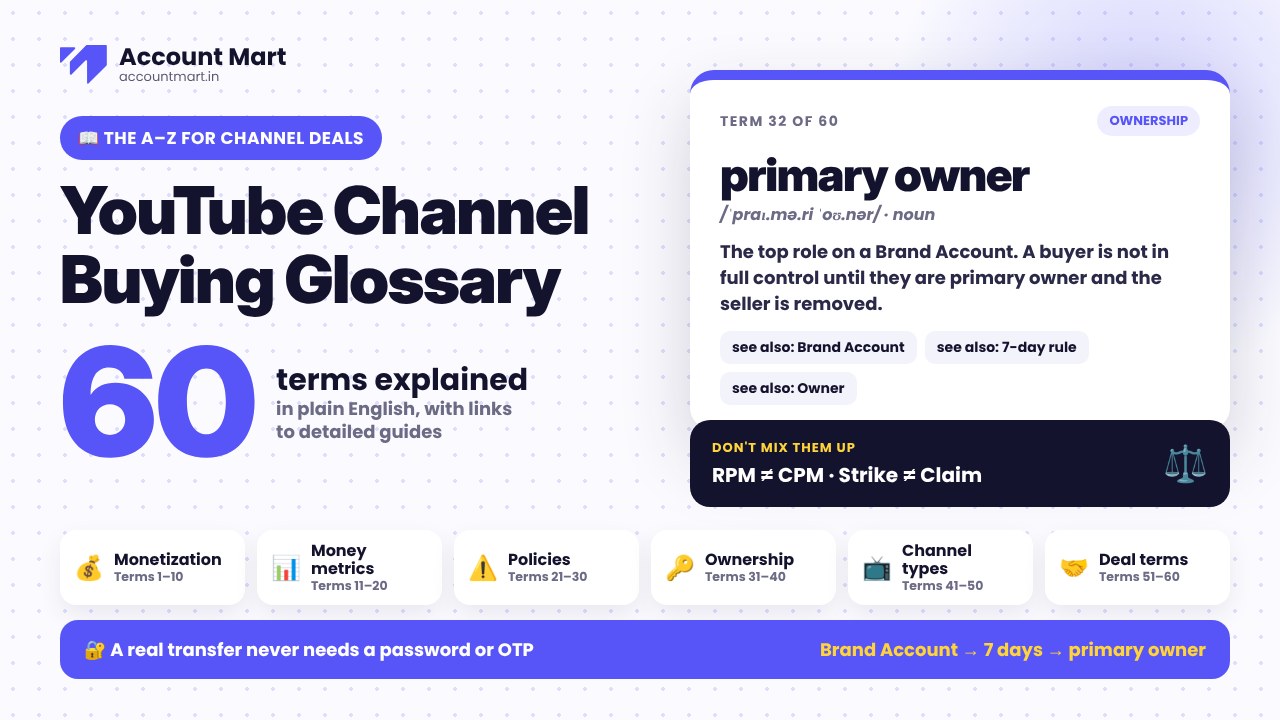
This glossary fixes that. We have collected the 60 terms that come up most in channel deals at Account Mart, explained each in one or two simple sentences, and linked to a detailed guide where one exists. The terms are grouped by topic, so you can read a whole section before a deal or jump straight to the word you need.
Start here: the 10 terms every buyer must know
If you only have five minutes, learn these first. They come up in nearly every channel deal.
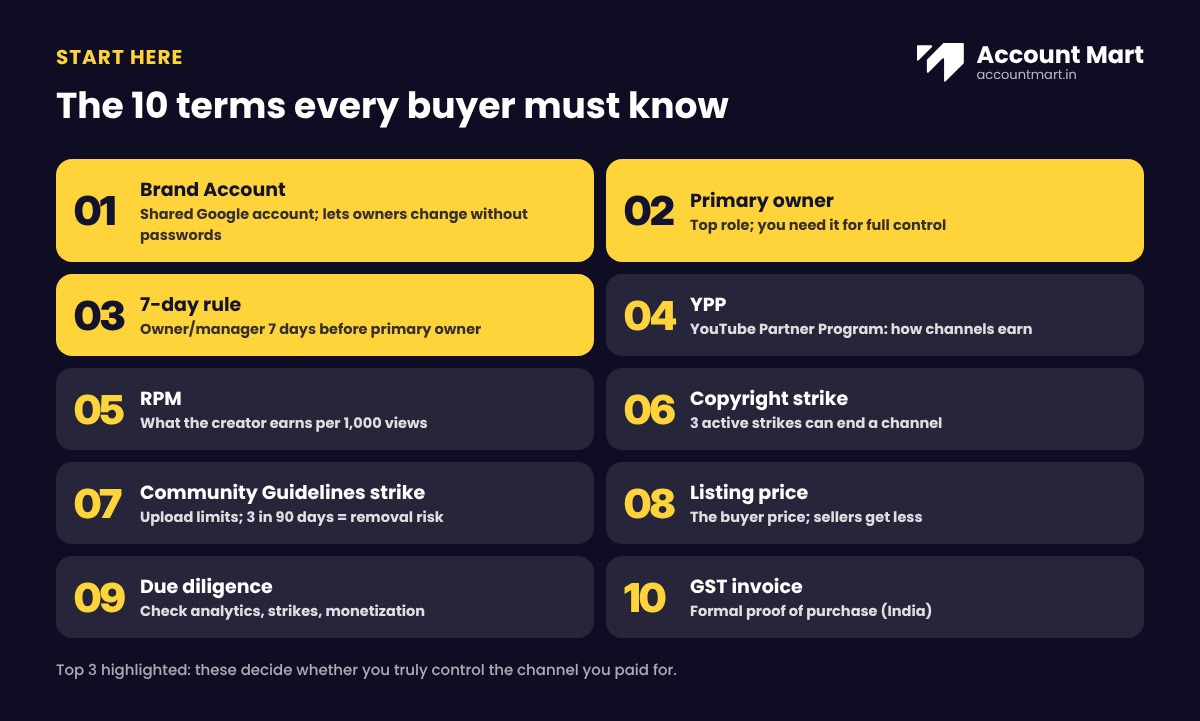
- Brand Account
- Primary owner
- 7-day rule
- YouTube Partner Program (YPP)
- RPM
- Copyright strike
- Community Guidelines strike
- Listing price
- Due diligence
- GST invoice
Each is explained in full below.
1. Monetization terms
1. YouTube Partner Program (YPP). YouTube's programme that lets creators earn money from their channel. It has two tiers: a fan funding tier and an ad revenue tier. See YouTube monetization requirements 2026.
2. Fan funding tier. The lower YPP tier: 500 subscribers plus 3,000 public watch hours in 12 months, or 3 million Shorts views in 90 days. It unlocks memberships, Super Chat, Super Thanks and shopping, but not ad revenue.
3. Ad revenue tier. Until 31 January 2027: 1,000 subscribers plus 4,000 watch hours in 12 months, or 10 million Shorts views in 90 days. This is what most buyers mean by "monetized".
4. 2027 YPP change. Announced on 10 August 2026 and confirmed on the YouTube Official Blog. From 1 February 2027, new applicants need 1,000 subscribers plus 8,000 watch hours or 20 million Shorts views. Existing partners must accept updated terms in Studio by 31 January 2027. Details: YPP 2027 changes.
5. Public watch hours. Total hours viewers spent watching a channel's public long-form videos in the last 12 months. Shorts views are counted separately, through the Shorts route to eligibility. Read how to get 4,000 watch hours.
6. Qualified Shorts views. The Shorts views YouTube counts toward eligibility and revenue. From February 2027, monetized channels need 10 million qualified Shorts views in the last 90 days to earn the monthly Shorts revenue share.
7. Revenue share. The part of ad revenue the creator keeps. YouTube's official blog says creators receive 55% of long-form ad revenue and 45% of their allocated Shorts Creator Pool revenue.
8. Shorts Creator Pool. The pot of Shorts ad revenue that YouTube shares out to eligible creators based on their share of views. Learn more in YouTube Shorts monetization.
9. Fan funding features. Channel memberships (monthly paid perks), Super Chat (paid highlighted messages in live chat) and Super Thanks (one-off tips on videos). See fan funding explained.
10. AdSense for YouTube. The Google payment account linked to a monetized channel. Earnings are paid through it. After buying a monetized channel, the new owner usually links their own. See how to change AdSense.
2. Money and performance metrics
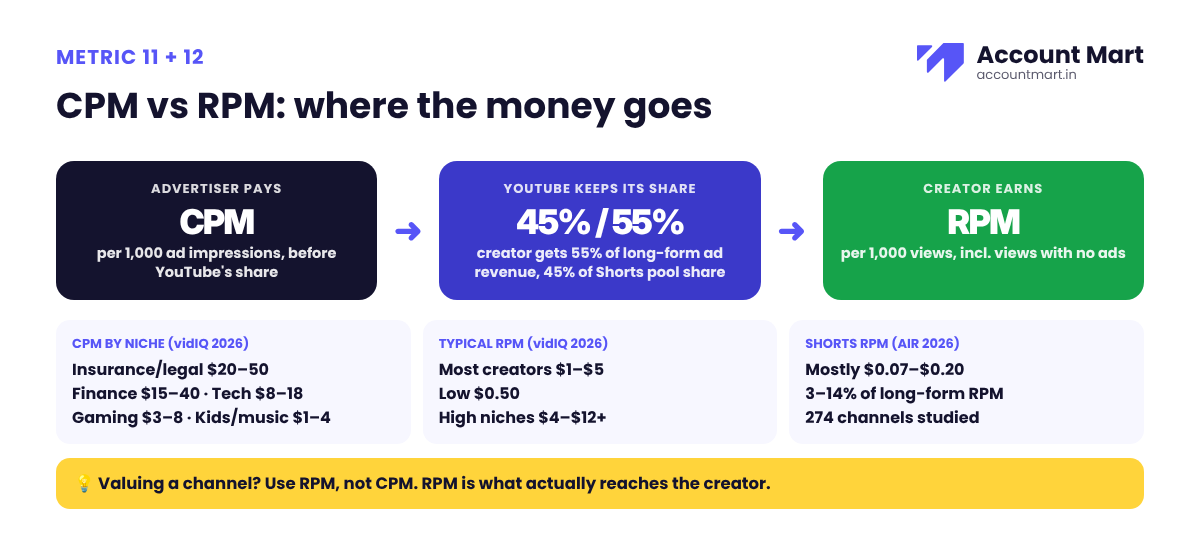
11. CPM (cost per mille). What advertisers pay per 1,000 ad impressions, before YouTube's share. It varies by niche and country. vidIQ's 2026 estimates range from $1–4 for kids and music up to $20–50 for insurance and legal.
12. RPM (revenue per mille). What the creator actually earns per 1,000 views, after YouTube's share and across all views, including those without ads. Most creators see $1–$5. Compare the two in RPM vs CPM.
13. Shorts RPM. RPM on Shorts is much lower than on long-form. AIR Media-Tech's 2026 study of 274 channels found Shorts RPM mostly between $0.07 and $0.20.
14. Views. The number of times videos were watched. Buyers should look at views over the last 28 and 90 days, not just lifetime totals.
15. Impressions click-through rate (CTR). The share of people who saw a video's thumbnail on YouTube and clicked it. It shows how strong a channel's titles and thumbnails are. See thumbnail tips.
16. Average view duration. How long, on average, viewers watch a video. Long view duration usually means the audience is genuinely interested, which helps both growth and earnings.
17. Mid-roll ads. Ads that play during a video. They can be placed on videos that are 8 minutes or longer, which is one reason long-form videos often earn more.
18. Seasonality. Ad rates change through the year. vidIQ estimates RPM of $1.50–3 in Q1 rising to $4–7+ in Q4, when advertisers spend most.
19. Audience geography. Where viewers live. It matters a lot: upGrowth's 2026 estimates put CPM around $33 in the US and under $1 in India. See CPM by country.
20. Payback period. How many months a channel takes to earn back its price: price ÷ average monthly earnings. For illustration, a ₹20,000 channel earning ₹2,000 a month pays back in 10 months.
3. Policy and penalty terms
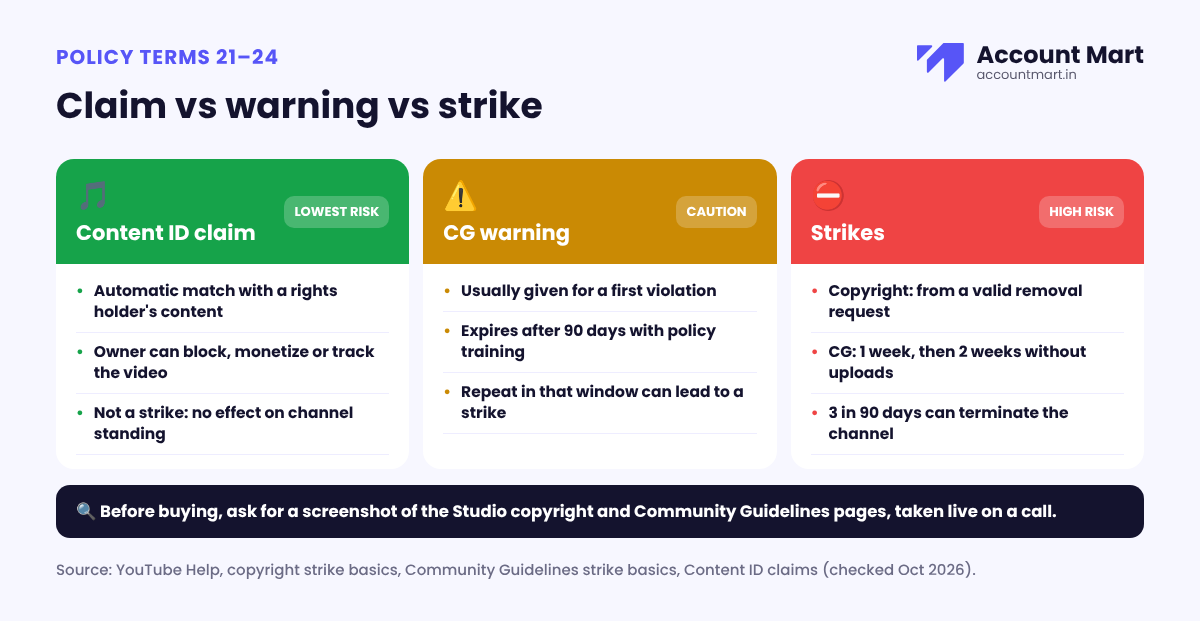
21. Copyright strike. A penalty after a valid copyright removal request. It expires after 90 days if you complete Copyright School and have fewer than three strikes. Three active strikes can terminate the channel. Read how to check strikes before buying.
22. Content ID claim. An automatic match against a rights holder's content. The owner can block, monetize or track the video. A claim is not a strike. See strike vs claim.
23. Community Guidelines warning. Usually the first step for a first-time violation. It expires after 90 days if the creator completes a policy training.
24. Community Guidelines strike. A penalty for breaking the rules again. A first strike blocks uploads for one week, a second within 90 days for two weeks, and three in 90 days can remove the channel. Details: Community Guidelines strikes.
25. Reused content. YouTube's monetization policy on channels that repost content already on YouTube or elsewhere without adding significant original commentary or value. It applies to the whole channel. See the reused content policy.
26. Inauthentic content. The name YouTube has used since July 2025 for mass-produced or repetitive content, such as template-made slideshows. It cannot be monetized.
27. Limited ads (yellow icon). A label showing a video has limited or no ads because it is not suitable for all advertisers. Good listings disclose it. See the yellow dollar sign.
28. Made for Kids. A setting for content aimed at children. Personalized ads, comments, notification bells, memberships and several other features are turned off. Read kids channel rules.
29. Demonetization. Losing ad revenue, either on single videos or for the whole channel when it is removed from YPP. Learn the causes and fixes.
30. Inactive account policy. Google's policy that a Google Account unused for 2 years may be deleted with its data. Owners of quiet channels should sign in regularly. See inactive channel policies.
4. Ownership and transfer terms
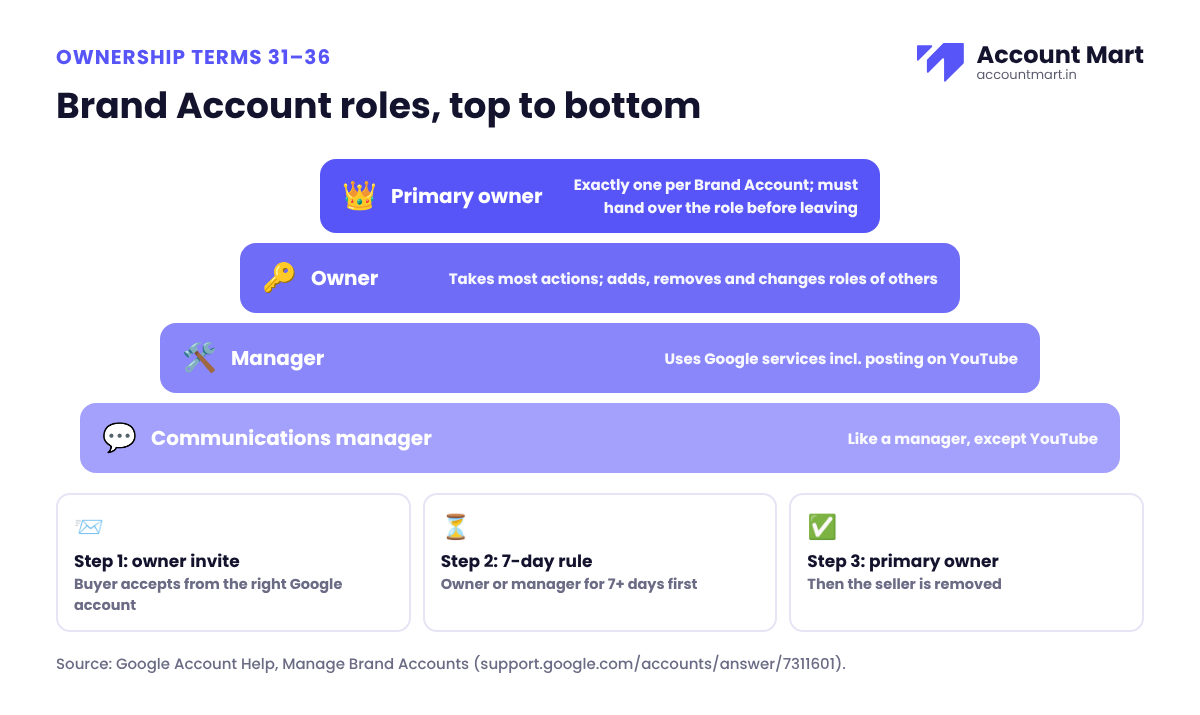
31. Brand Account. A Google account built to be shared by several people. Channels on a Brand Account can change owners without sharing passwords. Read Brand Account explained.
32. Primary owner. The top role on a Brand Account. Every Brand Account has exactly one, and the primary owner must hand the role to someone else before leaving. A buyer is not in full control until they are primary owner.
33. Owner. A role that can take most actions and controls who manages the account: owners add, remove and change other people's roles. A buyer is first added as owner.
34. Manager. A role that can use Google services that support Brand Accounts, including posting videos on YouTube. Google's help page does not list adding or removing people among a manager's powers.
35. Communications manager. A role that, according to Google's Brand Account help page, can do what managers do except use YouTube. It is rarely relevant in a channel sale.
36. 7-day rule. Google requires the new primary owner to have been an owner or manager for at least 7 days, and owners must have held the role for 7 days before removing other owners or managers. That is why transfers take about a week. See why transfers take 7 days.
37. Owner invite. The email invitation the seller sends to add the buyer as owner. The buyer must accept it from the right Google account.
38. Channel move. Moving a channel from a personal Google account to a Brand Account so it can be transferred. Covered in how to transfer channel ownership.
39. Handle. A channel's unique @name. New owners often change it after a sale. See change channel name and handle.
40. 2-Step Verification (2SV). An extra sign-in check beyond the password. Turn it on right after you take over a channel. See our 2SV setup guide.
5. Channel types and condition
41. Monetized channel. A channel in the YPP ad revenue tier. At Account Mart, monetized channels with 1K–10K subscribers start from ₹10,000–₹20,000 (about $105–$211). Learn how to check monetization.
42. Non-monetized channel. A channel not earning ad revenue yet. Most listings are non-monetized: a 1K–2K channel is ₹3,800–₹4,500 (about $40–$47). Compare in monetized vs non-monetized.
43. Shorts channel. A channel built mainly on Shorts. In our listings, 77% of non-monetized channels are Shorts channels. See Shorts channel prices.
44. Long-form channel. A channel built on regular videos. Long-form usually earns a higher RPM and builds watch hours.
45. Empty channel. A channel with subscribers but few or no videos, often sold for a fresh start. Read buy an empty channel.
46. Aged channel. An older channel. Age alone does not add much value; activity and audience matter more. See old vs new channel value.
47. Niche. The topic a channel covers, such as gaming, devotional or finance. Niche affects price and RPM. See price by niche.
48. Faceless channel. A channel where the creator does not appear on camera. Popular with buyers because it is easy to continue. Read buy a faceless channel.
49. Play Button (Creator Award). YouTube's award at 100K (Silver) and 1M (Gold) subscribers. YouTube says awards are for personal use and may not be sold, so the plaque usually stays with the creator. See Silver Play Button channels.
50. Fake subscribers. Subscribers bought or gained through bots or "sub4sub". YouTube's fake engagement policy bans this. Learn how to spot fake subscribers.
6. Deal and marketplace terms
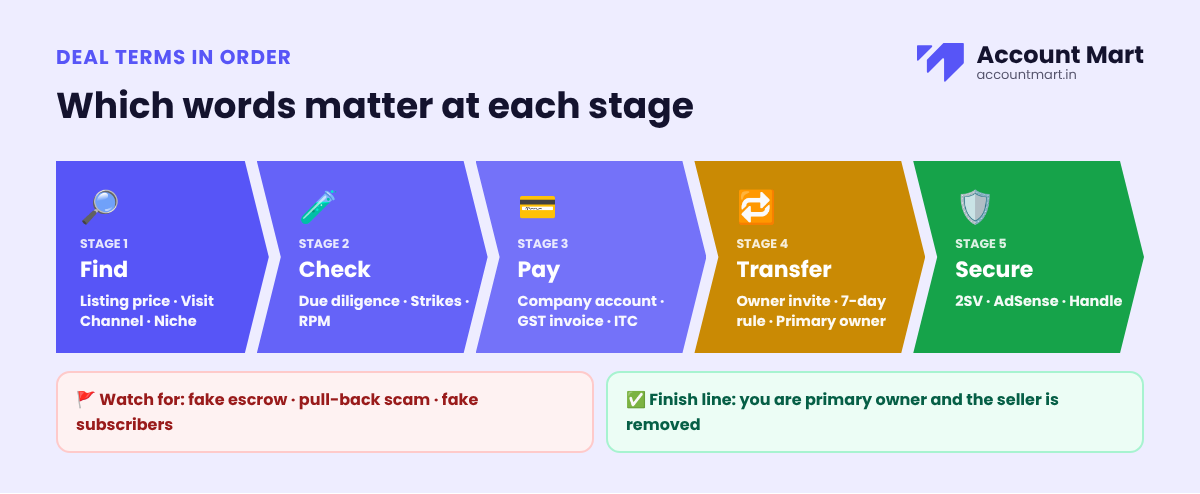
51. Listing price. The price a buyer pays, shown on the listing. At Account Mart, listed prices are buyer prices.
52. Seller payout. What the seller receives. It is lower than the listing price. See why sellers get less.
53. Valuation. An estimate of what a channel is worth. Price grows more slowly than subscribers: in our data, doubling subscribers adds only about 25% to price. Try a free valuation.
54. Due diligence. Checking a channel before you buy: analytics, strikes, monetization status and audience. Use our due diligence checklist.
55. Visit Channel button. A button on every Account Mart listing that opens the live channel, so you can see it yourself.
56. Escrow. A neutral third party that holds payment until a deal completes. It protects payment, not channel quality. Account Mart does not offer escrow: buyers pay MRC Account Mart Private Limited's registered company account and get a GST invoice. Compare both models in escrow vs registered company.
57. Fake escrow. A scam site that pretends to be escrow and shows "payment received" when no money exists. See fake escrow websites.
58. GST invoice. A tax invoice from a GST-registered business. Every Account Mart deal gets one by email and WhatsApp. Read buy with a GST invoice.
59. Input tax credit (ITC). A GST benefit that lets registered businesses offset GST paid on purchases. Business buyers should ask a Chartered Accountant.
60. Pull-back scam. When a seller transfers a channel, gets paid, and then takes it back through a role or login they kept. A full Brand Account transfer, with the seller removed, prevents it. See channel scams in India.
How to use this glossary in a real deal
Knowing the words is step one. Using them is step two. Before you pay for any channel, ask the seller to confirm these points in writing, using the exact terms above:
- Monetization status and tier (fan funding or ad revenue).
- Any active copyright strikes, Community Guidelines strikes or warnings.
- Any limited-ads labels, Content ID claims or Made for Kids settings.
- That the transfer will use the Brand Account system, ending with you as primary owner and the seller removed.
- The final listing price and what invoice you will receive.
For a full list, read 25 questions to ask before buying and our YouTube channel FAQ.
Frequently Asked Questions
What is the most important term when buying a channel?
Primary owner. You do not fully control a channel until you are its primary owner and the seller has been removed.
What is the difference between RPM and CPM?
CPM is what advertisers pay per 1,000 ad impressions. RPM is what the creator earns per 1,000 views after YouTube's share.
Is a Content ID claim the same as a strike?
No. A claim lets the rights holder block, monetize or track a video. Only strikes count toward channel termination.
What does "YPP-approved" mean?
That the channel has been accepted into the YouTube Partner Program. Ask which tier, because only the ad revenue tier earns from ads.
What is the 7-day rule?
A new owner must be an owner for at least 7 days before becoming primary owner. That is why transfers take about a week.
Does a channel come with its Play Button?
Usually not. YouTube says awards may not be sold, so the creator normally keeps the plaque.
What is reused content?
Content repurposed from YouTube or elsewhere without significant original commentary or value. It can stop a channel from being monetized.
What does "listing price" mean on Account Mart?
It is the price the buyer pays. Sellers receive less than the listing price.
Why does a GST invoice matter?
It is formal proof of purchase, and business buyers may be able to claim input tax credit. Ask a Chartered Accountant.
Where can I learn more about these terms?
Each term links to a detailed guide. Our YouTube channel FAQ answers 50 common questions.
Read these guides in your language
Many of our readers prefer to learn in their own language. The key buying, selling and transfer guides are also available in Indian languages:
- Hindi: buy a channel, sell a channel, 7-day transfer, monetization rules
- Bengali: buy a channel · Marathi: buy a channel · Telugu: buy a channel · Tamil: buy a channel
- Gujarati: buy a channel · Kannada: buy a channel · Malayalam: buy a channel · Punjabi: buy a channel · Odia: buy a channel
Ready to put the words to work?
- Browse YouTube channels for sale
- Sell your channel or get a free valuation
- YouTube channel price guide
- How to buy a YouTube channel
Account Mart (MRC Account Mart Private Limited, Jaipur) has 500+ channels in stock and a team in the channel business since 2018. Official numbers: +91 72400 00934, +91 72400 00935, +91 72400 00936. Calls or messages from any other number using the Account Mart name are not from us.
Sources: YouTube Help — YPP overview, copyright strike basics, Community Guidelines strike basics, Content ID claims, monetization policies, made for kids features, fake engagement policy; Google Help — Brand Accounts, inactive account policy; YouTube Official Blog — YPP explained; vidIQ; AIR Media-Tech; upGrowth 2026 CPM estimates; YouTube Creator Awards. Prices: Account Mart live listings, October 2026.
About the author: Ridhaan Choudhary is the Founder & CEO of Account Mart. An entrepreneur, YouTuber and influencer with 450K+ Instagram followers, he has been in the YouTube channel business since 2018 and has spoken about YouTube growth and channel deals on podcasts and in news interviews.