Quick answer: The YouTube Shorts algorithm doesn't reward hashtags, posting times or upload volume. YouTube shows each new Short to a small group of viewers who may enjoy it, watches how they respond (did they watch or swipe away, did they keep watching, like, share or subscribe) and then widens or slows its reach. Since 24 August 2026, view counts start from the first frame, but YouTube still uses engaged views for retention and earnings. Since 1 October 2026, channels that mostly re-upload other creators' clips get less reach.
· 10 min read · By Ridhaan Choudhary, Founder & CEO
Key takeaways
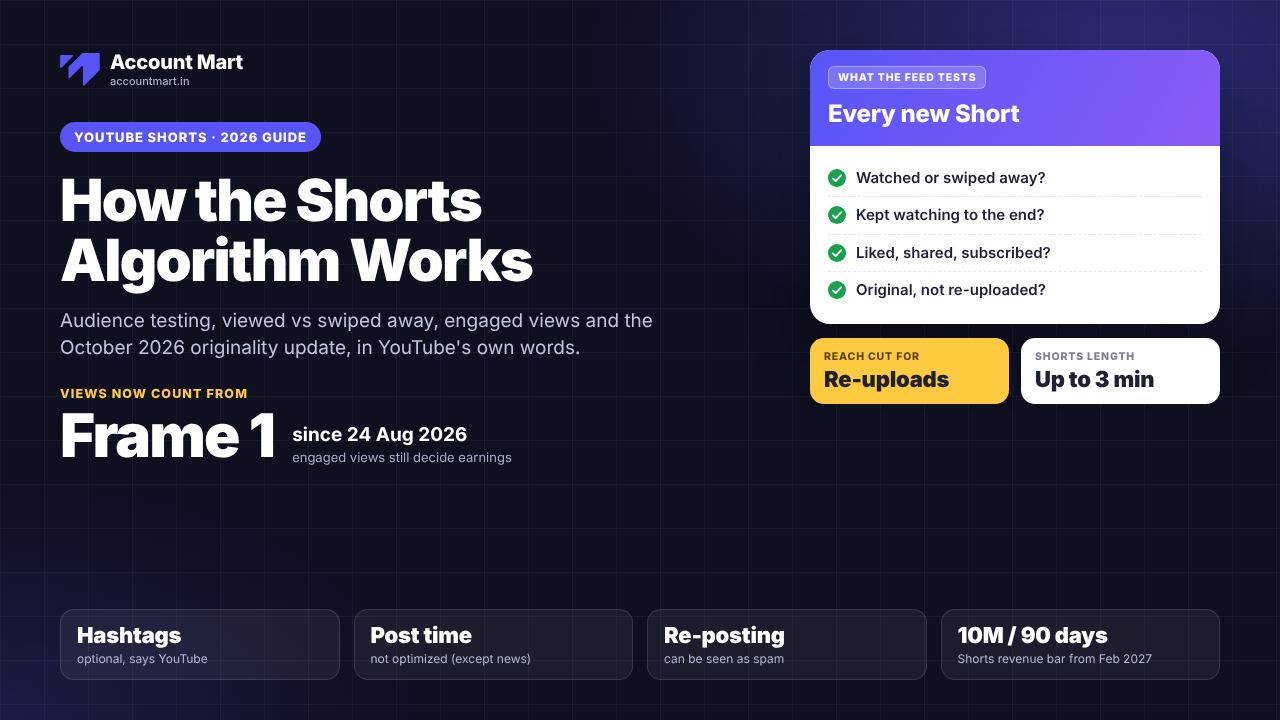
- YouTube's Shorts team describes the system as trying to "find a set of people that may enjoy your video", then expanding or tapering from there (TechCrunch, 2023).
- "Viewed vs swiped away" in YouTube Studio shows how often people chose to watch your Short instead of swiping past it. It is the best measure of your opening.
- Hashtags are optional, posting time rarely matters (news is the exception), and deleting and re-posting a Short can be treated as spam.
- From 24 August 2026, a view counts from the first frame. Engaged views keep the old definition and still drive retention metrics and earning eligibility.
- From 1 October 2026, YouTube gives less reach to channels that mainly aggregate or re-upload other creators' clips without significant changes.
How the Shorts feed is different from long videos
On the Home page and in search, a viewer reads titles, looks at thumbnails and picks a video. In the Shorts feed nobody picks. People swipe, and the next video simply plays. YouTube's Shorts product lead Todd Sherman explained in 2023 that this is why the two systems behave differently: long-form recommendations lean on the choice a viewer made, while "the Shorts feed prioritizes a more diverse feed", because people move through many more videos in one session (TechCrunch).
That one difference explains most of what creators notice about Shorts. A Short can reach people who have never heard of your channel. A strong Short from a tiny channel can travel far. And a Short that misses with its first audience can stop within hours.
"The audience is the algorithm"
YouTube has repeated this idea for years: its systems don't judge a video on its own, they follow what viewers do with it. YouTube's own explainer says recommendations use "viewing behaviour, likes, dislikes, subscriptions and feedback, including from satisfaction surveys", together with the reputation and quality of a channel (How YouTube Works). For a Short, the viewer's first decision, keep watching or swipe, is the loudest signal you control.
How YouTube tests a new Short
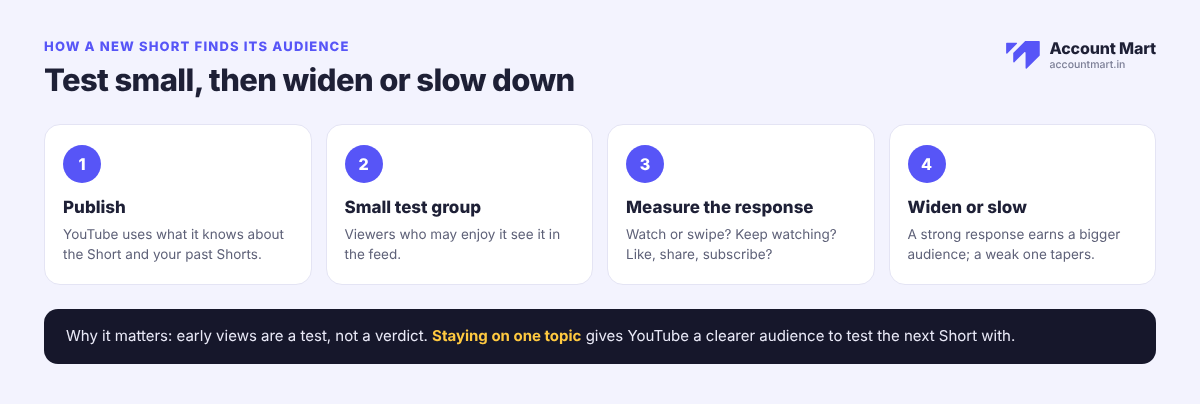
When you publish, the system tries to "find a set of people that may enjoy your video", as Sherman put it. Depending on how that group responds, the Short's traffic grows or tapers off. That is why some Shorts seem to get stuck after a few hundred views while others keep climbing for days.
In plain words, the loop looks like this:
- You publish. YouTube uses what it already knows about the Short and about how your earlier Shorts did with different viewers.
- A first group sees it. These are viewers whose behaviour suggests they might enjoy it.
- Their response is measured. Did they watch or swipe away? Did they keep watching, like, share, comment or subscribe?
- Reach widens or slows. A strong response earns a bigger and broader audience. A weak one slows the Short down.
Two lessons follow. First, early views are a test, not a verdict on your whole channel. Second, the audience a Short reaches depends on who responded well, so a channel that stays on one topic gives the system a clearer audience to test the next Short with.
The signals you can actually influence
Viewed vs swiped away
Shorts analytics in YouTube Studio include a viewed vs swiped away figure: the share of times people chose to watch your Short rather than swipe past it. It is the closest thing YouTube gives you to a hook score. If it is low, the first second isn't working. The opening frame, the first line or the promise of the Short isn't landing with the viewers it was shown to.
How much of the Short people watch
Average view duration and average percentage viewed show whether people stayed to the end. On Shorts that loop, the average can pass 100%, which means people watched more than once. A clear payoff at the end, and an ending that flows back into the start, keeps people watching. For reading these numbers properly, see our guide to YouTube Analytics.
Satisfaction: likes, shares, comments and subscribes
YouTube lists likes, dislikes, subscriptions and survey feedback among its recommendation signals. A Short that makes people subscribe or share tells the system much more than a passive view does. Ask for the action that fits the video, not for everything at once.
What YouTube says matters less than you think
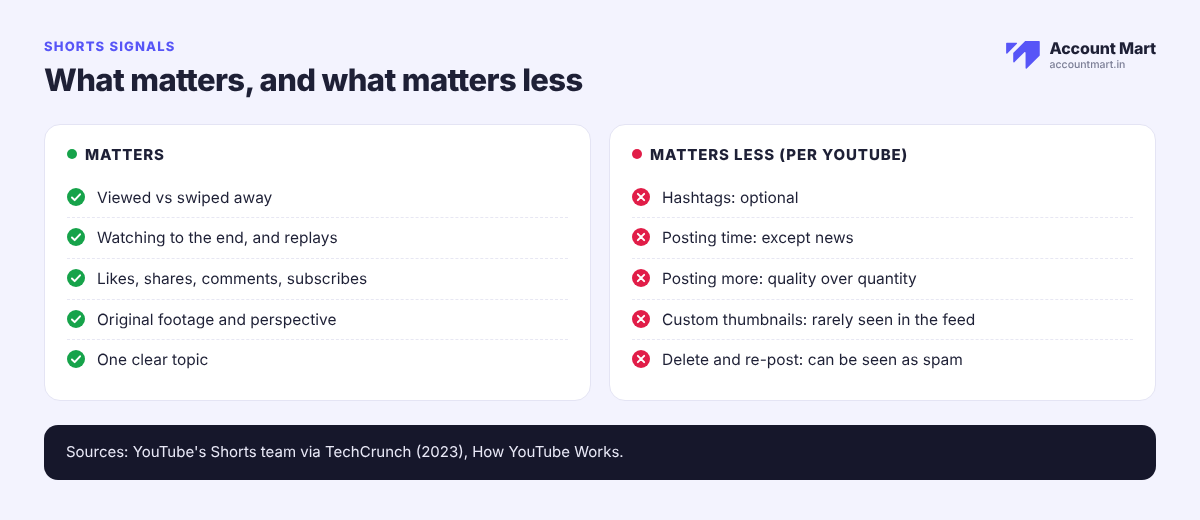
- Hashtags: they can tie a Short to a topic or event, but YouTube's Shorts team has said they are not required.
- Posting time: time of day isn't something YouTube optimizes for. News is the exception, because freshness matters there.
- Posting volume: posting more doesn't unlock anything. Sherman's advice was "quality over quantity".
- Custom thumbnails: in the feed, "most thumbnails are never seen", because viewers swipe straight into the video.
- Delete and re-post: re-uploading a Short to get a second chance can be seen as spam by YouTube's systems.
These points come from YouTube's Shorts team answering creator questions, as reported by TechCrunch in August 2023.
How Shorts views are counted now
View counting changed twice, and both changes matter when you read your numbers.
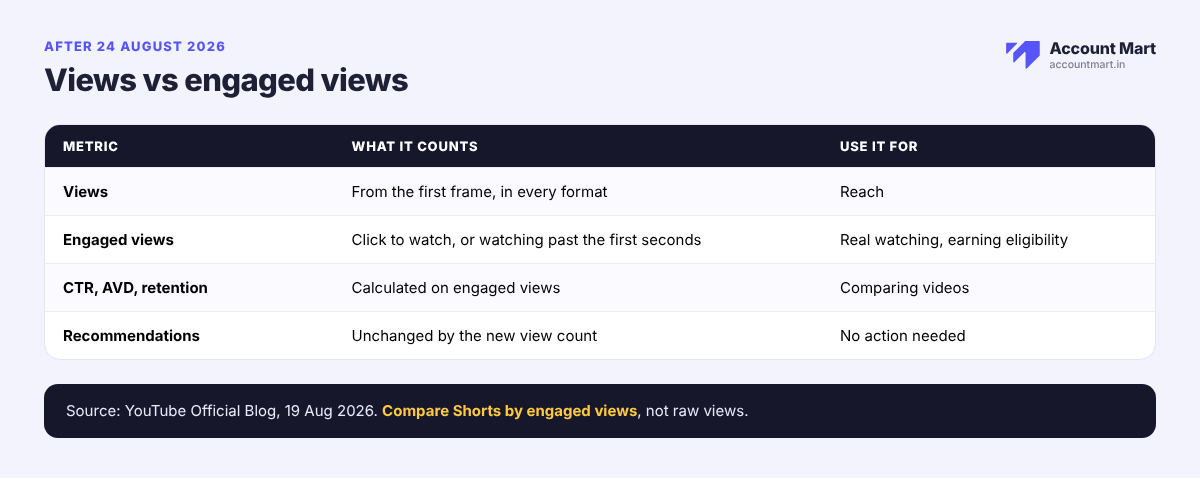
- 31 March 2025: Shorts views started counting every time a Short starts to play or replay, with no minimum watch time. The older definition, a view after a short watch threshold, moved to a separate metric called engaged views.
- 24 August 2026: YouTube applied first-frame counting to every format: Shorts, long videos, podcasts and live. YouTube says CTR, average view duration and retention still use engaged views, recommendations are unchanged, and an engaged view is how you qualify to earn (YouTube Official Blog, 19 August 2026).
In practice, your view count now measures reach, and engaged views measure real watching. When you compare two Shorts, compare engaged views and viewed vs swiped away, not raw views. When you look at a Shorts channel to buy, ask for both numbers. A huge view count with weak engaged views is a warning sign. Our guides to Shorts channel prices and monetized Shorts channels go deeper.
The October 2026 originality update
On 1 October 2026, YouTube's Creator Liaison Rene Ritchie said in a Creator Insider video that YouTube is updating its recommendation system to "further prioritize original Shorts". Channels that "mainly aggregate or re-upload other creators' clips without significant changes" will get less reach (Search Engine Journal).
He was also specific about what doesn't count as adding value: voice-over descriptions of what is happening on screen, minor technical edits, or template-based bulk changes. To share another creator's video, he pointed to the Posts tab, so viewers watch the original upload.
This builds on a rule that already applied to money. YouTube's reused content policy says borrowed content must be changed significantly before it can be monetized. A clip channel could already lose monetization; since October 2026 it can lose reach too. If you are looking at a Shorts channel built on clips, read our reused content policy guide first.
What counts as original in practice:
- Your own footage, voice, script or performance.
- Your own analysis, opinion or teaching around a topic.
- Storytelling a viewer couldn't get from the source clip alone.
Length, format and links
Since 15 October 2024 you can upload Shorts up to three minutes long. YouTube has never named an ideal length. Sherman's advice was to ask "to what length do you need to tell your story?" A complete 20-second Short beats a 90-second one with a slow middle.
You can also link a related video to a Short. It is the cleanest way to move Shorts viewers to your long videos, which usually earn far more per view (see how much YouTube pays per 1,000 views).
Do Shorts hurt long videos?
YouTube said in 2023 that it doesn't see Shorts cannibalizing long-form videos. Still, people who swipe through Shorts don't automatically sit through a 15-minute video. If you run both formats, link Shorts to related long videos, keep the topics close, and watch your traffic sources to see whether Shorts viewers actually move across.
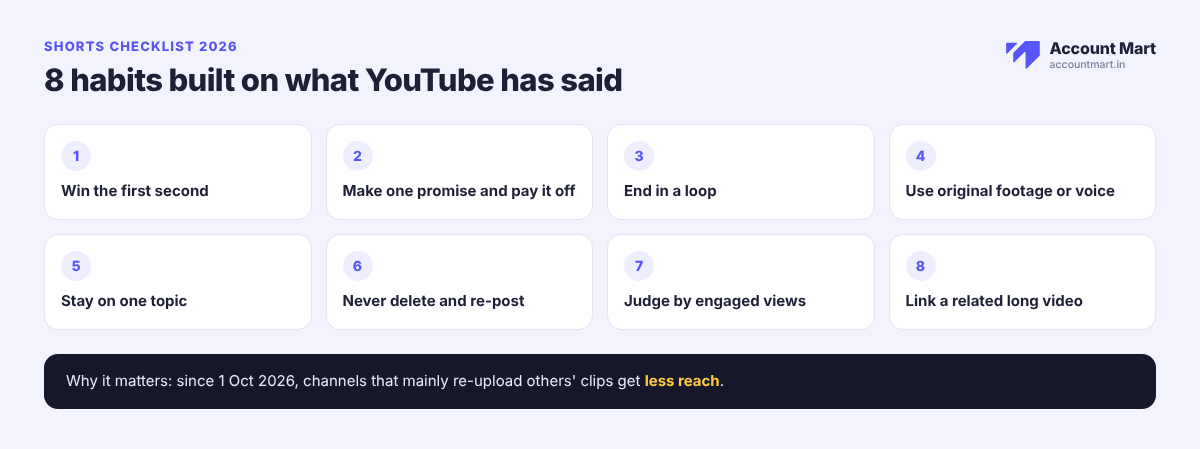
A Shorts checklist built on what YouTube has said
- Win the first second. Open on the most interesting frame, not a logo or a greeting.
- Make one clear promise and pay it off before the end.
- End in a way that loops back to the start.
- Use your own footage, voice or perspective. After October 2026 this is about reach, not only money.
- Stay on a topic, so YouTube can find the same kind of viewer again.
- Don't delete and re-post a Short that underperformed. Make the next one better instead.
- Judge Shorts by viewed vs swiped away and engaged views, not by raw views.
- Link a related long video whenever you have one.
Sherman's advice for a Short that disappoints is simple: "learn from it and move forward and try again."
What the algorithm means for a Shorts channel's value
The Shorts algorithm explains why two channels with the same subscriber count can be worth very different amounts. Subscribers don't decide who sees a Short; recent audience response does. When you price a Shorts channel, look at:
- Engaged views over the last 90 days, and whether they are steady or falling.
- Viewed vs swiped away on recent uploads.
- Originality: the creator's own content or re-uploaded clips. The October 2026 update raised this risk.
- Audience country, because ad rates differ hugely by country (see YouTube CPM by country).
- Monetization status and, from 1 February 2027, whether the channel reaches 10 million qualified Shorts views in 90 days. That is the new bar for sharing in Shorts ad and subscription revenue (YouTube Official Blog).
More detail in our guides to Shorts monetization and getting 10 million Shorts views, and in the due diligence checklist for buyers.
Frequently Asked Questions
How does the YouTube Shorts algorithm work?
YouTube shows a new Short to a group of viewers who may enjoy it, then widens or narrows its reach based on how they respond: whether they watch or swipe away, keep watching, like, share or subscribe.
Do hashtags help Shorts get views?
They can link a Short to a topic or event, but YouTube's Shorts team has said they are not required. A strong opening matters far more.
What is the best time to post a Short?
YouTube says time of day isn't something its systems optimize for. News is the exception, because freshness matters. Post when you can keep a steady rhythm.
Should I delete and re-upload a Short that flopped?
No. YouTube has warned that deleting and re-posting can be seen as spam. Turn the idea into a better new Short instead.
What does "viewed vs swiped away" mean?
It is the share of times viewers chose to watch your Short instead of swiping past it, shown in YouTube Studio. It is the best measure of how well your opening works.
Why did my view count jump in August 2026?
From 24 August 2026, YouTube counts a view from the first frame in every format. Engaged views keep the old definition and still drive retention metrics and earning eligibility.
Do custom thumbnails matter for Shorts?
Very little in the feed, where viewers swipe straight into the video. They still help where Shorts appear as tiles, such as your channel page and search results. See our thumbnail tips.
Do re-uploaded clips still get reach?
Less than before. Since 1 October 2026, YouTube gives less reach to channels that mainly aggregate or re-upload other creators' clips without significant changes.
How long should a Short be?
As long as the idea needs, up to three minutes. Short and complete usually beats long and slow.
Can I buy a Shorts channel instead of starting from zero?
Yes. Account Mart lists Shorts channels with the real price, a Visit Channel button and any strikes, warnings or claims shown upfront. Check engaged views and originality before you pay.
Want a Shorts channel with an audience already?
Browse ready channels on the Account Mart Shorts page, compare prices on the YouTube channel price index, or call +91 72400 00934 / +91 72400 00935 / +91 72400 00936 and tell us your budget and niche. Running a Shorts channel you want to sell? Get a free valuation on the sell accounts page.