Quick answer: To buy a podcast YouTube channel, look past the subscriber count and check three things: how much watch time the long episodes produce, how much of the audience depends on the host or a few famous guests, and whether a clips strategy feeds new viewers into full episodes. Podcast channels are strong for YouTube's watch-hour rules, which double to 8,000 hours for new applicants from February 2027. On Account Mart, small non-monetized channels list from about ₹3,800 (about $40), and monetized small channels from ₹10,000–₹20,000 (about $105–$211).
· 12 min read · By Ridhaan Choudhary, Founder & CEO
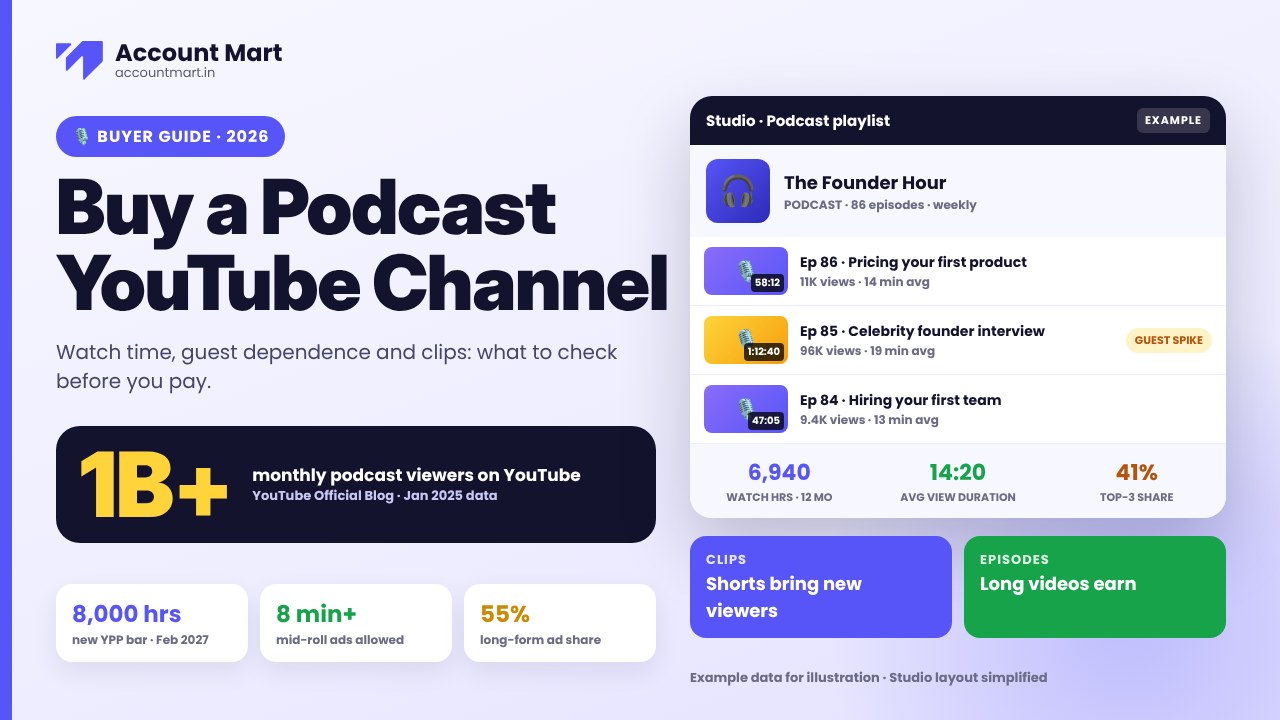
Key takeaways - Podcasts are big on YouTube: more than 1 billion monthly active podcast viewers (YouTube, January 2025). - Long episodes build watch hours fast, which matters more after the 8,000-hour rule starts on 1 February 2027. - The biggest risk is host and guest dependence: the audience may follow a person, not the channel. - Clips (Shorts and short highlights) are the discovery engine; full episodes are the earnings engine. - Check the RSS feed, podcast playlists and sponsor deals separately: they are not the same as the channel.
Podcasts have become one of the most watched formats on YouTube. People put a long conversation on the TV, listen while they drive, and watch short clips on their phone. For a buyer, that creates a very specific kind of channel: fewer uploads, longer videos, deep loyalty, and a lot of watch time per viewer.
But a podcast channel is also one of the hardest channels to buy well. The audience often comes for a voice, a personality or a famous guest, and that does not transfer with the channel. This guide explains how to judge a podcast channel before you buy it: the watch-time math, the guest-dependence test, the clips strategy, the podcast-specific settings in YouTube Studio, realistic earnings, prices, and a plan for the first 90 days.
Why Buy a Podcast YouTube Channel in 2026?
YouTube said in February 2025 that it had passed 1 billion monthly active viewers of podcast content (as of January 2025), and that people watched over 400 million hours of podcasts a month on living-room devices in 2024. A large share of podcast viewing now happens on TV screens, where viewers sit through long videos.
That matters for three reasons:
- Watch time. A single 60-minute episode can produce more watch hours than dozens of short explainers.
- Ad space. YouTube allows mid-roll ads on videos 8 minutes or longer, and almost every podcast episode is longer than that.
- Loyalty. Podcast viewers come back every week. Returning viewers are the most stable audience a channel can have.
There is also a timing reason. From 1 February 2027, new applicants to the ad-revenue tier of the YouTube Partner Program (YPP) need 1,000 subscribers plus 8,000 public watch hours in 12 months (or 20 million Shorts views in 90 days). YouTube confirmed this on its official blog, and the details are on YouTube Help. Long-form podcast channels are one of the few formats that can reach 8,000 hours without enormous view counts. Read our full explainer on the YouTube Partner Program 2027 changes.
The Watch-Time Math: Why Long Episodes Win
Subscribers do not pay. Watch time and views do. Here is a simple way to see why podcast channels are watch-time machines.
Watch hours per 1,000 views = 1,000 × average view duration (in minutes) ÷ 60.
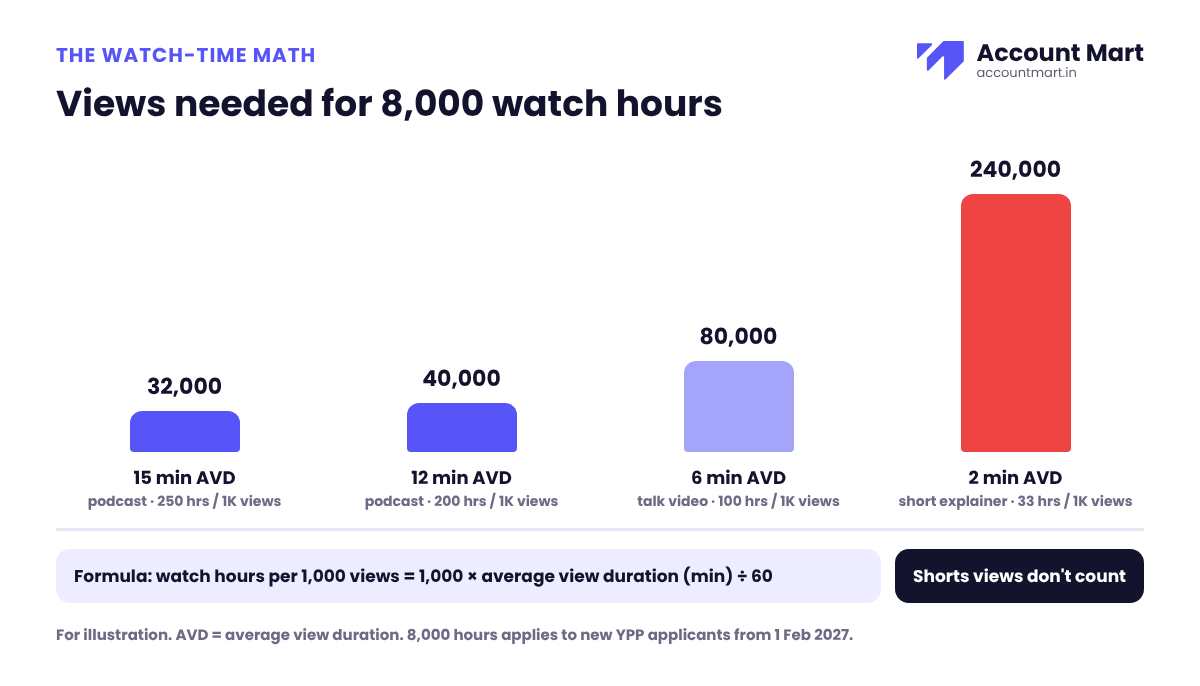
For illustration only:
- A podcast episode with a 12-minute average view duration gives about 200 watch hours per 1,000 views. To reach 8,000 hours, the channel needs about 40,000 long-form views in a year.
- A 6-minute average gives 100 hours per 1,000 views: about 80,000 views for 8,000 hours.
- A short explainer with a 2-minute average gives about 33 hours per 1,000 views: about 240,000 views for the same 8,000 hours.
Remember that Shorts views do not count toward public watch hours. So when you look at a podcast channel, ask for the average view duration of full episodes, not just total views. A channel with 20,000 views a month at a 15-minute average is worth more for monetization than one with 60,000 views at 90 seconds. Our guides on how to get 4,000 watch hours and increasing YouTube watch time go deeper.
Types of Podcast Channels You Can Buy
Not all "podcast channels" are the same asset. Before you compare prices, know which type you are looking at.
- Interview podcast with a fixed host. One host talks to a new guest each week. Big reach, but very high host dependence.
- Solo or commentary podcast. One person talks about a topic: business, tech, cricket, spirituality. The topic carries part of the value, the voice carries the rest.
- Panel or friends podcast. Two to four regular voices. The chemistry is the product, so it rarely survives a change of cast.
- Clips channel. Short highlights from long episodes. Grows fast, but check who owns the original episodes.
- Audio-first channel (RSS). Episodes uploaded from a podcast RSS feed. YouTube turns them into static-image videos using the show art. Easy to run, lower engagement.
- Faceless narrative podcast. Story, history, crime or facts told with a narrator voice and visuals. The easiest type to continue after a sale, because no famous face is involved. See also our guide to buying a faceless YouTube channel.
The Guest-Dependence Test: The Biggest Risk
Here is the uncomfortable truth about podcast channels: the host does not come with the channel. When you buy, you get the channel, its videos, its subscribers and its history. You do not get the person whose voice and face the audience knows. Guests are even less tied to the channel. One famous guest can produce a viral episode that makes the channel look much bigger than its normal level.
Use this test before you agree to a price.
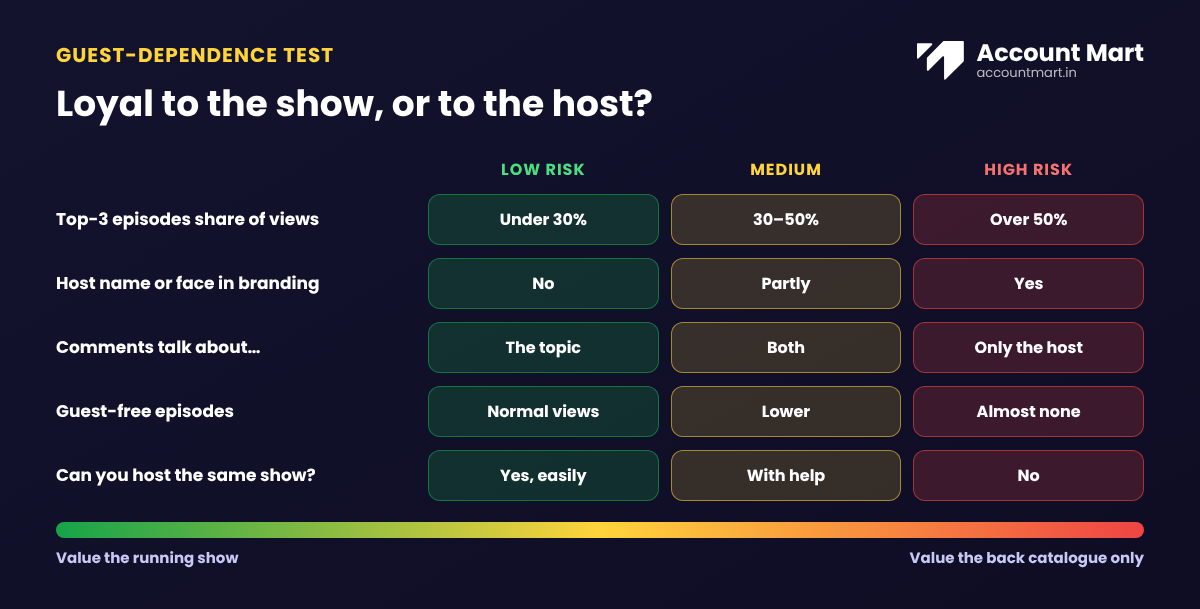
1. Top-episode share
Ask for views by video for the last 12 months in YouTube Studio. If the top three episodes bring more than half of all views, the channel depends on a few hits, often with famous guests. Value it on the typical episode, not the best one.
2. Host-in-the-title check
Does the channel name, logo or banner use the host's name or face? If yes, a rebrand will be needed, and some viewers will leave when the host leaves. Our guide to rebranding a bought YouTube channel explains how to do this slowly.
3. Returning vs new viewers
A high share of returning viewers is good news only if they return for the topic. Read the comments on recent episodes. Are people talking about the subject, or only about the host?
4. Guest-free episodes
Look at episodes with no guest, or with an unknown guest. If those still get decent views, the format has value on its own.
5. Can you continue it?
Ask yourself honestly: can you (or someone you hire) host the same kind of show at the same quality? If the answer is no, you are buying a back catalogue and a subscriber base, not a running show. That can still be a good deal, but the price should reflect it.
The Clips Strategy: Shorts Bring Viewers, Episodes Earn
Most successful podcast channels on YouTube work on two levels: short clips for discovery and full episodes for watch time and earnings.
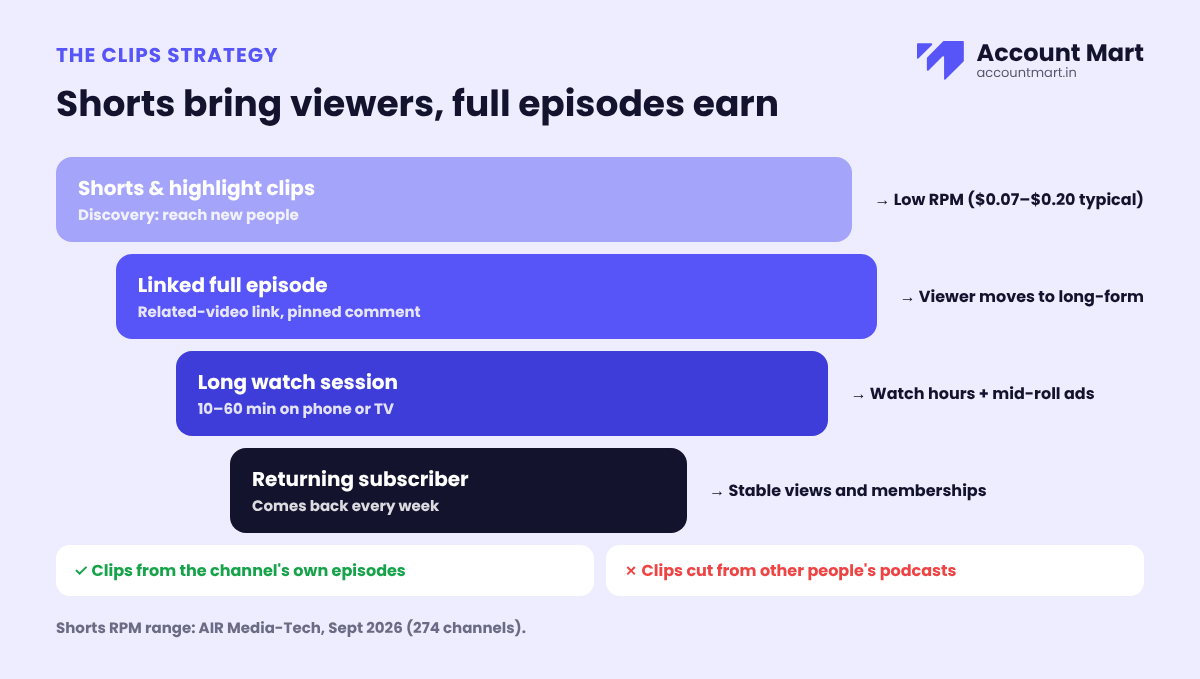
How to judge the clips side of a channel:
- Are clips linked to full episodes? Each Short or highlight should point viewers to the full episode (through a related-video link, pinned comment or description).
- Are clips on the same channel or a separate one? Some shows run a second clips channel. If it is not part of the sale, the main channel may lose a big traffic source after the transfer.
- Who made the original footage? A clips channel that cuts other people's podcasts without permission is a risk. YouTube's reused content policy says channels that repurpose content already on YouTube or elsewhere, without adding substantial value, can lose monetization, and such clips also attract copyright claims. Read our reused content policy guide.
- Shorts views vs Shorts earnings. Shorts can bring huge reach, but Shorts RPM is low. AIR Media-Tech's 2026 study of 274 channels found Shorts RPM mostly between $0.07 and $0.20, or 3–14% of long-form RPM. So clips are mostly a marketing cost, not an income line. See our YouTube Shorts monetization guide.
Podcast Settings in YouTube Studio: What to Check
YouTube treats podcasts in a special way. Before you buy, ask the seller to show these settings on a screen share.
Podcast playlists
On YouTube, a podcast show is a playlist, and the episodes are videos in that playlist. A creator can create a new podcast in Studio or add podcast features to an existing playlist. YouTube recommends a square show thumbnail (1280 × 1280) and says only full-length episodes belong in a podcast; clip playlists should not get podcast features. Shorts made to support a podcast do not appear in YouTube Music. (Source: Create a podcast in YouTube Studio.)
What to check: is the main show set up as a podcast playlist, with episodes in the right order, a clear title (not just "Podcast"), and the podcast badge on its pages?
RSS feed delivery
Audio-first creators can deliver episodes to YouTube through an RSS feed. YouTube uses the show art to make a static-image video for each episode. Ownership of the feed is verified through the email address on the feed, and new feed episodes upload automatically. (Source: Deliver podcasts using an RSS feed.)
This creates a hidden transfer issue that most buyers miss:
- The RSS feed and the hosting account are separate from the YouTube channel. If the seller keeps the feed connected, new episodes from the seller's show may keep appearing on your channel.
- Deleting a video on YouTube does not remove it from the feed, and YouTube may upload it again. To hide an episode, it must be set to private or removed from the feed too.
- Ads inside the audio. YouTube's RSS help page says podcast content uploaded this way cannot contain advertisements under its Terms of Service, and branded content or sponsorships must be declared. Ask whether old episodes contain baked-in ad reads.
Agree in writing what happens to the feed: disconnected before transfer, or handed over with the hosting account.
Sponsors and branded content
Many podcast channels earn more from sponsors than from YouTube ads. Sponsor deals usually belong to the host or their company, not to the channel. Treat sponsor income as non-transferable unless the sponsor has agreed in writing to continue with the new owner.
How Much Can a Podcast YouTube Channel Earn?
Podcast earnings come from three places: YouTube ads (if the channel is in YPP), fan funding (memberships, Super Chat, Super Thanks), and sponsors. Only the first two belong to the channel.
For YouTube ads:
- Creators receive 55% of the ad revenue on long-form videos (YouTube Official Blog).
- vidIQ (April 2026) puts most creators at about $1–$5 RPM (earnings per 1,000 views), with finance, insurance, legal and B2B topics at $4–$12 or more.
- Niche CPM ranges in the same report: business $12–30, finance $15–40, tech $8–18, education $6–15, health $8–20, entertainment $2–7.
- Audience country matters a lot. upGrowth's 2026 estimates put CPM at about $33 in the US, $24 in the UK and $36 in Australia, but under $1 in India.
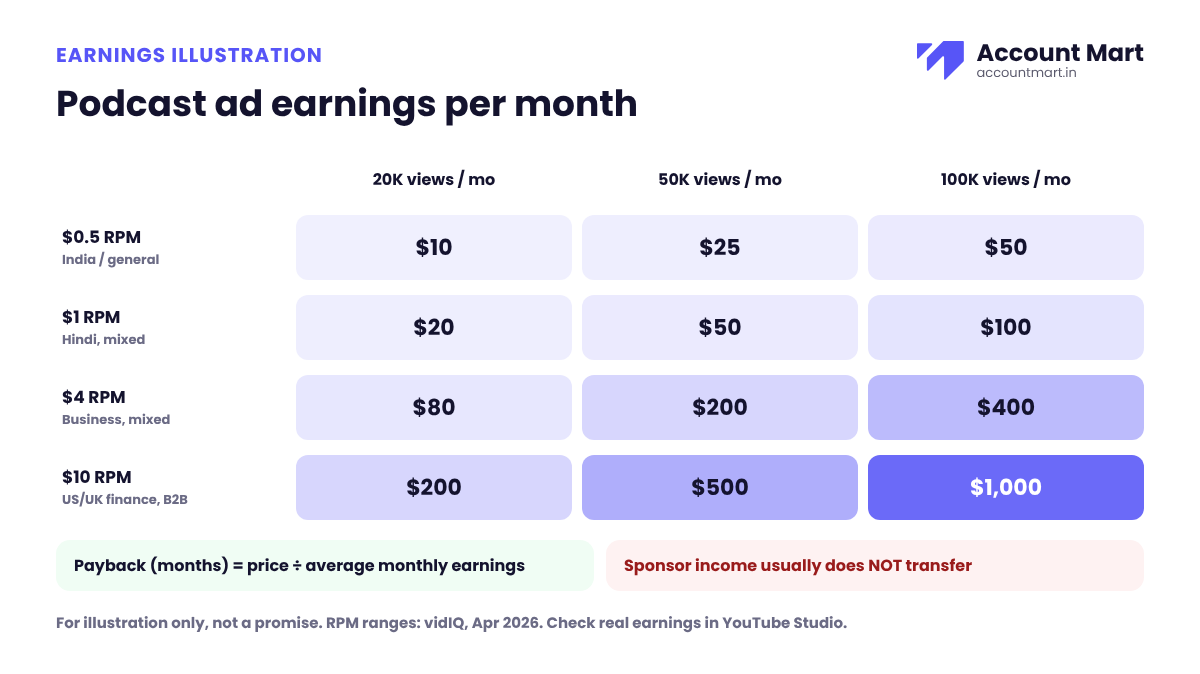
For illustration only, with a monetized long-form podcast channel getting 50,000 episode views a month:
- At $1 RPM (Hindi or general audience): about $50 a month.
- At $4 RPM (mixed audience, business topic): about $200 a month.
- At $10 RPM (US/UK-heavy finance or B2B audience): about $500 a month.
Payback = price ÷ average monthly earnings. A channel bought for ₹20,000 (about $211) that earns $50 a month pays back in about 4 months; at $10 a month it takes almost 2 years. These are illustrations, not promises. Check real earnings in Studio. Our guide on how much YouTube pays per 1,000 views explains RPM in detail.
Podcasts also suit fan funding. With the lower YPP tier (500 subscribers plus 3,000 public watch hours in 12 months, or 3 million Shorts views in 90 days), a channel can unlock memberships, Super Chat and Super Thanks without ad revenue. See YouTube fan funding.
Podcast YouTube Channel Prices on Account Mart
We do not have enough podcast-only listings to publish a separate podcast median, and about 77% of our non-monetized listings are Shorts channels. Long-form channels are rarer in our stock. So use our general buyer prices (October 2026) as the guide:
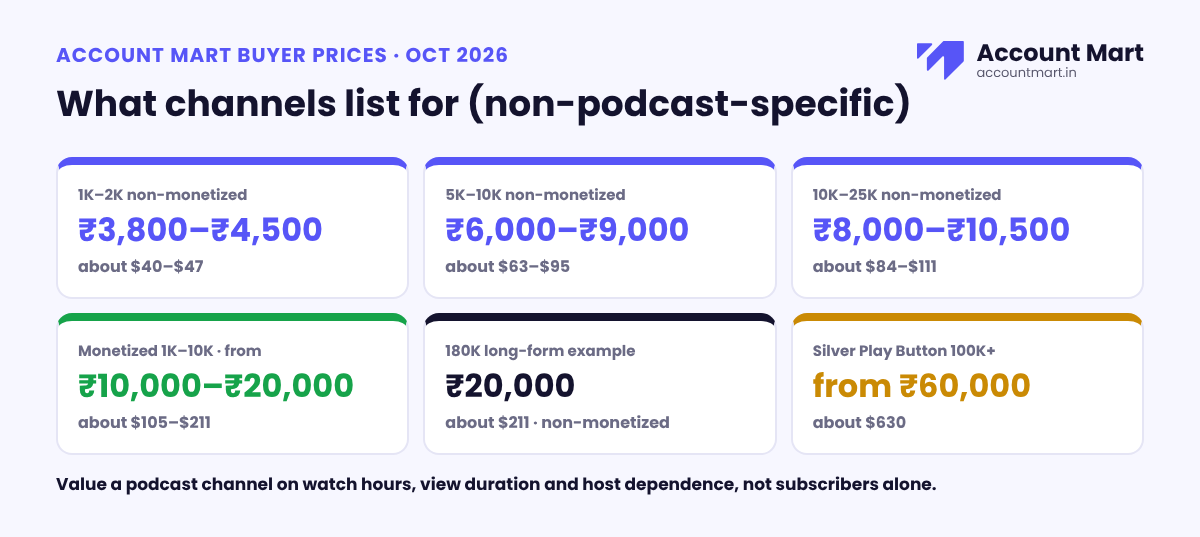
- 1K–2K subscribers (non-monetized): ₹3,800–₹4,500 (about $40–$47)
- 5K–10K: ₹6,000–₹9,000 (about $63–$95)
- 10K–25K: ₹8,000–₹10,500 (about $84–$111)
- 60K+ (non-monetized): ₹15,000–₹26,000 (about $158–$274). One example in our data: a 180K long-form channel listed at ₹20,000 (about $211).
- Monetized 1K–10K: from ₹10,000–₹20,000 (about $105–$211)
- Silver Play Button channels (100K+): from ₹60,000 (about $630), depending on condition
Price grows much more slowly than subscribers: in our data, doubling subscribers adds only about 25% to the price. For a podcast channel, the things that really move value are watch hours in the last 12 months, average view duration, and how much the audience depends on one person. For niche price patterns, read YouTube channel price by niche. If you want a podcast channel specifically, call the team: many of our 500+ channels are not yet listed on the website.
Due Diligence Checklist for a Podcast Channel
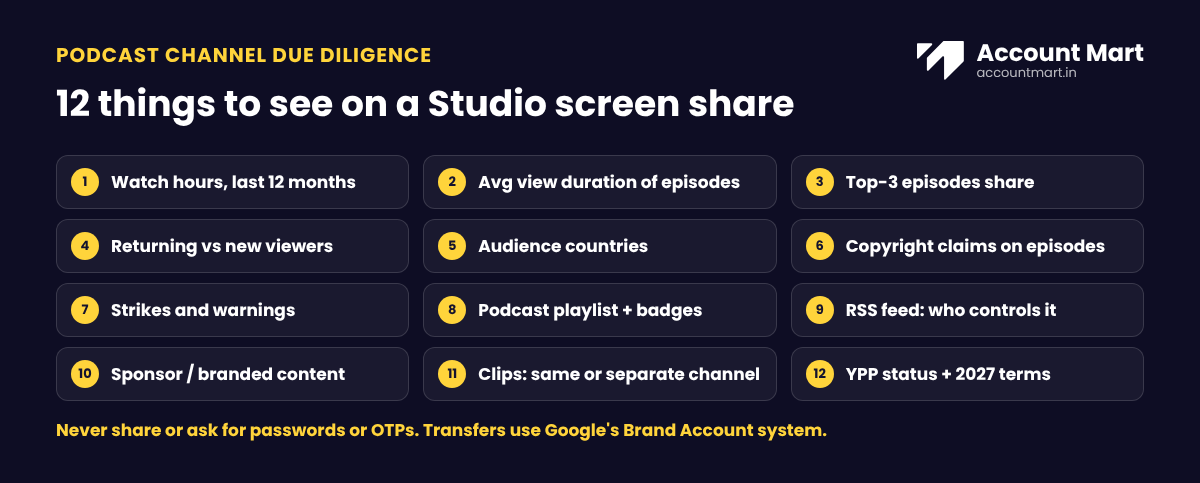
On a live screen share of YouTube Studio, check:
- Public watch hours in the last 12 months (Shorts do not count).
- Average view duration for full episodes.
- Views by episode: top three episodes' share of the total.
- Returning vs new viewers.
- Audience countries (this decides RPM).
- Copyright section: claims on episodes (music beds, TV clips, guest-supplied media).
- Strikes and warnings: none, or fully explained.
- Podcast playlist setup and badges.
- RSS feed connection and who controls it.
- Sponsor and branded-content declarations.
- Clips: same channel or separate; who owns the footage.
- Monetization status and, for YPP channels, whether the updated 2027 terms are accepted.
Use our full YouTube channel due diligence checklist and verify analytics before buying guide for the rest.
Your First 90 Days After Buying
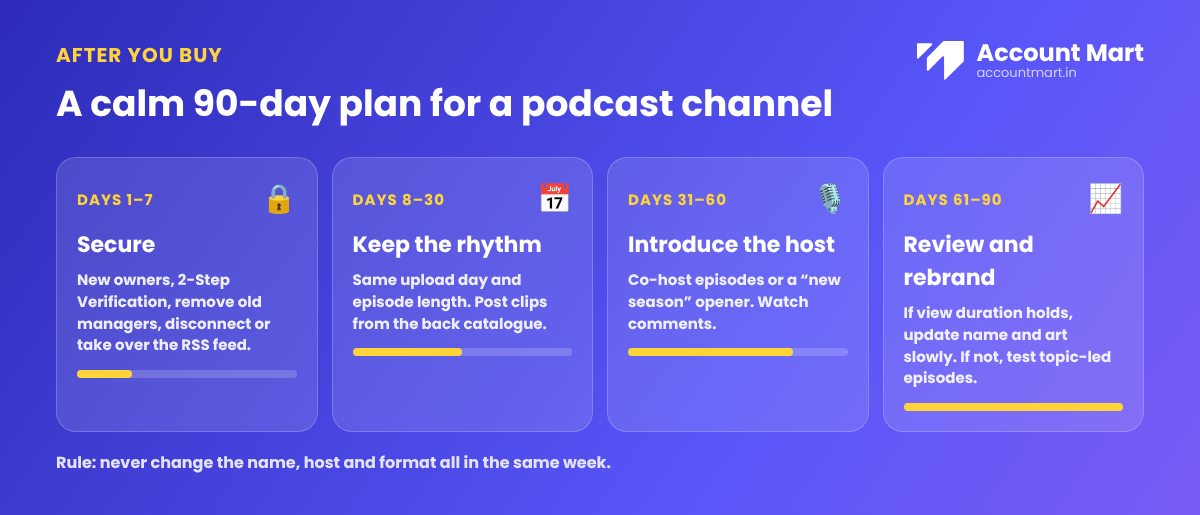
A podcast channel can lose its audience quickly if the change of hands is rough. A calm plan:
- Days 1–7: Secure the channel (new owners, 2-Step Verification, remove old managers). Disconnect or take over the RSS feed. See secure a YouTube channel after buying.
- Days 8–30: Keep the same upload day and episode length. Post clips from the back catalogue to keep the channel active while you record new episodes.
- Days 31–60: Introduce the new host or format gradually, for example as a co-host or with a "new season" episode.
- Days 61–90: Review average view duration. If it holds, rebrand the name and art slowly. If it drops, test topic-led episodes that do not depend on any one person.
Mistakes to Avoid When Buying a Podcast Channel
- Valuing the channel on one viral guest episode.
- Ignoring the RSS feed, so the seller's new episodes keep landing on your channel.
- Counting sponsor income as part of the channel's earnings.
- Buying a clips channel built from other people's podcasts.
- Changing the name, host and format all in the first week.
- Paying an anonymous seller outside a verifiable process. Read YouTube channel scams in India.
Buying Safely With Account Mart
Every Account Mart listing shows the real price, a Visit Channel button, and any strikes, warnings, claims or limited-ads labels. You pay MRC Account Mart Private Limited's registered company account, get a GST invoice by email and WhatsApp, and our sales team guides the transfer and setup. The transfer uses Google's Brand Account system: you are invited as an owner and, after 7 days, become primary owner. Nobody shares passwords or OTPs. Learn more in transfer YouTube channel ownership.
Our team has worked in the channel business since 2018, the Account Mart app has 500K+ downloads on Google Play, and @accountmartofficial has 50K+ followers on Instagram. Official numbers only: +91 72400 00934, +91 72400 00935, +91 72400 00936. Any other number claiming to be Account Mart is fake; verify before you pay.
Frequently Asked Questions
Is a podcast YouTube channel a good buy?
It can be, if the audience comes for the topic and format and you can keep producing episodes. If the audience follows one host, value it mainly as a back catalogue.
Do podcast channels reach watch hours faster?
Usually yes. Long episodes with a good average view duration produce many watch hours per view, which helps with the 4,000-hour rule today and the 8,000-hour rule for new applicants from 1 February 2027.
Do Shorts clips count toward watch hours?
No. Shorts views count toward the Shorts-views path, not public watch hours.
Does the host come with the channel?
No. You buy the channel, videos and subscribers. The host is a person and is not part of the sale unless a separate agreement says so.
What happens to the podcast RSS feed?
It is separate from the channel. Agree before payment whether it will be disconnected or handed over, so old or new episodes do not reappear unexpectedly.
Can I keep the sponsors?
Only if the sponsor agrees in writing. Treat sponsor income as non-transferable by default.
Can I change the podcast name after buying?
Yes, but do it slowly. A sudden change of name, host and art can confuse loyal viewers.
How much does a podcast channel cost?
Account Mart buyer prices start at ₹3,800 (about $40) for small non-monetized channels and from ₹10,000–₹20,000 (about $105–$211) for monetized 1K–10K channels.
Are mid-roll ads possible on podcast episodes?
Yes. YouTube allows mid-roll ads on videos 8 minutes or longer, if the channel is monetized.
Can international buyers buy a podcast channel?
Yes. Contact the team on the official numbers to discuss the deal and payment.
How long does the transfer take?
At least 7 days, because Google requires you to be an owner for 7 days before you can become primary owner.
Find Your Podcast Channel
- Browse channels: Buy Accounts
- Buying guide: how to buy a YouTube channel in India
- Monetized options: buy a monetized YouTube channel
- Selling your podcast channel? Sell Accounts
- Call: +91 72400 00934, +91 72400 00935, +91 72400 00936
Sources: YouTube Official Blog, 1 billion monthly podcast users (Feb 2025) and YouTube Partner Program explained; YouTube Help: YPP eligibility, Create a podcast in YouTube Studio, Deliver podcasts using an RSS feed, reused content policy; vidIQ (Apr 2026); AIR Media-Tech (Sept 2026); upGrowth country CPM estimates (2026); Account Mart listing data (48 live listings, October 2026).
About the author: Ridhaan Choudhary is the Founder & CEO of Account Mart. An entrepreneur, YouTuber and influencer with 450K+ Instagram followers, he has worked in the YouTube channel business since 2018 and has talked about YouTube growth and the channel business on podcasts and in news interviews.